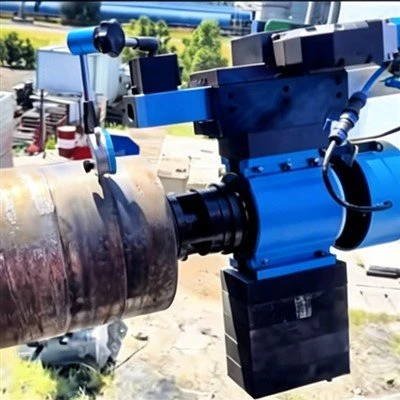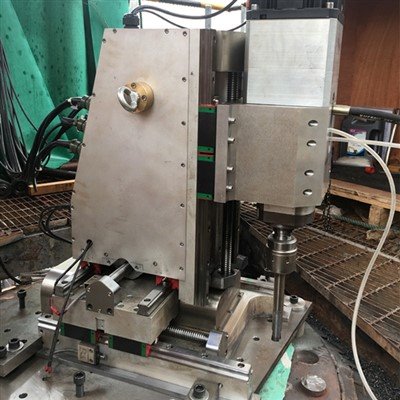

In the realm of mechanical maintenance and emergency equipment repair, the portable shaft-end lathe serves as an indispensable "lifesaver." It eliminates the need to dismantle and transport heavy shaft components to a workshop; instead, turning operations can be completed directly on-site, saving a significant amount of labor and time. However, many users make a common mistake when selecting this equipment: focusing solely on the shaft diameter. Consequently, they may encounter issues such as the machine failing to securely clamp the workpiece during processing, failing to meet required precision standards, or even causing damage to the equipment or the workpiece itself. In reality, when selecting a portable shaft-end lathe for shafts of varying diameters, the critical factor is correctly matching the technical parameters. Today, we will discuss this in detail; whether you are machining a small-diameter transmission shaft or a large-diameter motor shaft, these key matching points are essential to keep in mind.
The primary parameters to match are the machining diameter and the clamping range; these constitute the fundamental and most critical specifications. The machining diameter of a portable shaft-end lathe is always clearly specified-for instance, a unit might be labeled for a "machining diameter of 100mm," while another specifies "200mm." However, one must not rely solely on this single figure; it is equally important to consider the actual clamping range. For example, when machining small-diameter shafts (under 50mm), one should select a unit with a clamping range of 20–100mm. Such units feature smaller chucks with concentrated clamping force, enabling them to firmly secure small shafts and prevent slippage during machining. Conversely, when machining medium-to-large diameter shafts (100–200mm), a unit with a clamping range of 50–200mm is required; furthermore, the chuck should feature a 3-jaw or 4-jaw self-centering mechanism to accommodate shafts of varying diameters while ensuring clamping concentricity. A word of caution here: it is advisable to select a unit with a specified machining diameter that is 10–20mm larger than the actual diameter of the shaft being processed. This provides a sufficient margin to prevent processing failures caused by slight deviations in the shaft's actual diameter.
The second key parameter is the spindle speed range, which directly impacts both machining precision and efficiency; shafts of different diameters have vastly different requirements regarding rotational speed. For small-diameter shaft components (e.g., 20–50 mm), the rotational speed can be set slightly higher; since the shafts themselves are lightweight and possess low inertia, high speeds facilitate smoother cutting and result in a finer surface finish. Therefore, it is advisable to select equipment with a spindle speed range of 50–500 rpm. Conversely, large-diameter shaft components (e.g., 150–200 mm) are heavy and possess high inertia; setting the speed too high can easily induce equipment vibration-or even damage the spindle-so a lower rotational speed is required. Equipment with a speed range of 30–300 rpm is appropriate in such cases. Furthermore, a high-quality portable shaft-end lathe should feature a variable-speed function, allowing for flexible adjustment based on the shaft diameter and specific machining requirements-for instance, utilizing high speeds for small shafts and low speeds for large shafts-thereby ensuring adaptability across a wide range of scenarios.
Next is the power output, which is directly correlated with the shaft diameter and material composition. Machining small-diameter shafts made of relatively soft materials (e.g., aluminum alloy shafts) does not impose high power demands; equipment with an output of 1.5–2.2 kW is sufficient. Excessive power, in this context, can lead to energy waste and potentially damage the workpiece due to excessive cutting forces. However, when machining large-diameter shafts made of hard materials (e.g., carbon steel or alloy steel shafts), greater cutting force is required; in such instances, equipment with an output exceeding 3.0 kW should be selected to ensure adequate power reserves, thereby facilitating smooth turning operations and preventing the motor from "stalling" under load. It is important to note here that "more power is not always better"; the power output must be appropriately matched to the specific shaft diameter and material to avoid either insufficient power or excessive wear and tear on the equipment.
Finally, there are the tool post travel and cutting depth specifications, which determine the machining flexibility and operational scope of the equipment. For small-diameter shafts, the machining allowance (material to be removed) is typically minimal; thus, a tool post travel of 100–150 mm and a cutting depth of 3–5 mm are sufficient to meet requirements. In contrast, large-diameter shafts may require the removal of a significantly larger amount of material-for example, in cases where the shaft end has sustained severe wear-necessitating a greater cutting depth. Consequently, for such applications, it is advisable to select equipment featuring a tool post travel of 200 mm or more and a cutting depth capacity of 5–8 mm. Furthermore, the feed rate adjustment function of the tool post is of critical importance. Shafts of varying diameters require different feed speeds: smaller shafts can be processed with a faster feed rate to enhance efficiency, whereas larger shafts necessitate a slower feed speed to ensure machining precision. Consequently, the equipment must be capable of facilitating fine-tuning of the feed rate.
Attention must also be paid to the equipment's adaptability and stability parameters. For instance, when machining long shaft-type components, one should select a portable shaft-end lathe equipped with a tailstock support; the tailstock provides additional support, thereby preventing the shaft from bending or deforming during the machining process. When machining large-diameter shafts, the method by which the equipment's base is secured is crucial; selecting a unit featuring adjustable feet or suction cups allows it to be firmly anchored to the ground or workbench surface, thereby minimizing vibration. Additionally, the weight of the equipment warrants consideration: machining small-diameter shafts places minimal demands on equipment weight-a lightweight, easily portable unit suffices. Conversely, machining large-diameter shafts requires equipment with substantial mass to ensure stability; therefore, selecting a unit weighing between 50 and 100 kg strikes an optimal balance-it remains manageable for transport while simultaneously meeting the stability requirements for machining operations.
Ultimately, the core principle behind selecting a portable shaft-end lathe is to "prescribe the right remedy for the specific ailment." One must match key parameters-such as machining range, spindle speed, power output, and tool post travel-to the specific diameter of the shaft component, subsequently fine-tuning the details based on the material composition and specific machining requirements. For small-diameter shafts, the emphasis lies on "flexibility, high speed, and precision"; for large-diameter shafts, the focus shifts to "stability, high power, and extended travel." By ensuring these parameters are appropriately aligned, the equipment can effectively fulfill its role in on-site operations, thereby guaranteeing both machining quality and operational efficiency.